
With scientists from Brazil, Uruguay, the Falkland Islands, Spain, China and South Korea participating, the event aims to build a regional database and update scientific knowledge in order to assess the abundance and exploitation status of Argentine shortfin squid (Illex argentinus), which supports the largest fishery by landed volume in the South Atlantic Ocean.
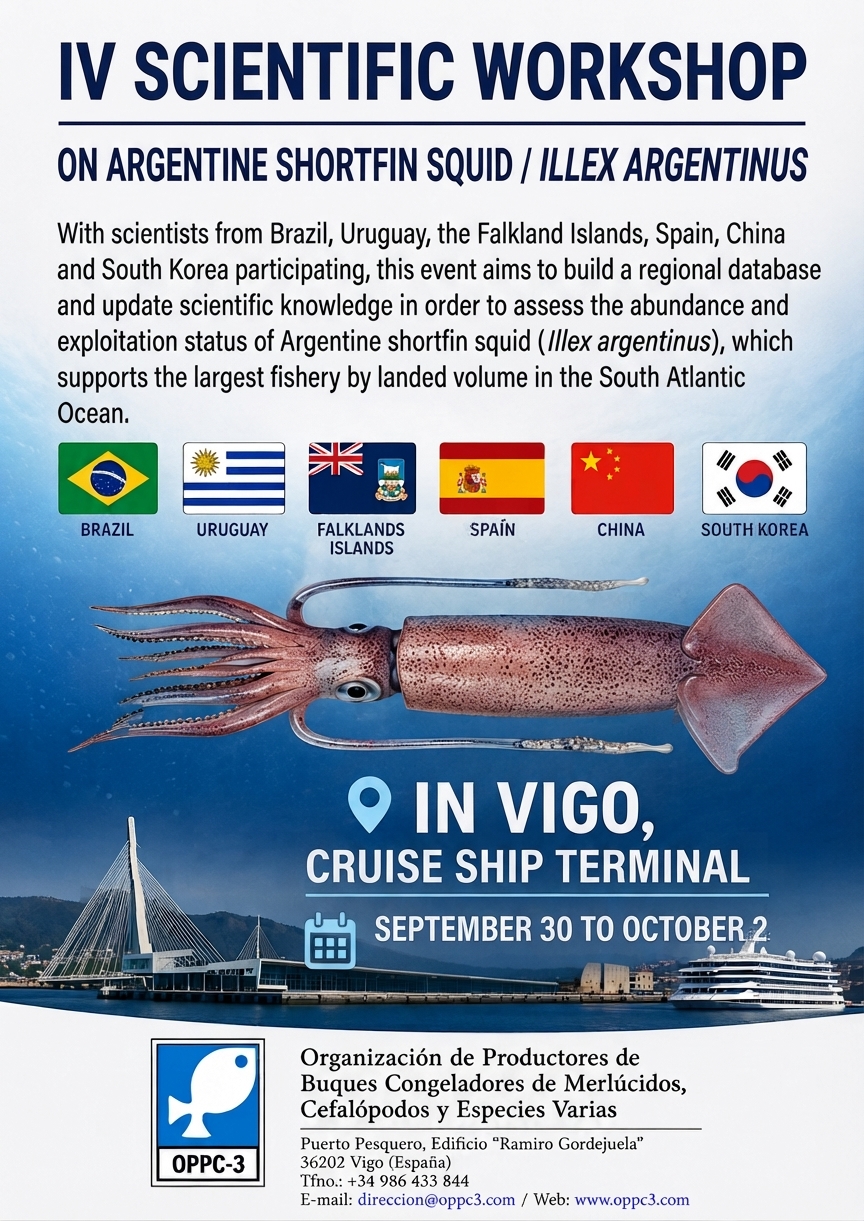
The workshop aims to continue advancing the development of a shared regional database and improve scientific knowledge of the abundance, productivity and exploitation status of this species, which supports the largest fishery by landing volume in the South Atlantic.
The initiative is organized and funded by the Organization of Producers of Freezer Trawlers for Hake, Cephalopods and Other Species (OPPC3), with facilitation support from Sustainable Fisheries Partnership (SFP).
A Further Step Toward Science-Based Management
The workshop forms part of an international scientific cooperation process that began with meetings held in Chile and Panama and continued with a scientific gathering in Bangkok. The Vigo meeting represents a new step forward in strengthening collaboration between scientists and representatives of the fleets harvesting Illex argentinus throughout the Southwest Atlantic.
The fishery operates across waters shared by multiple nations and fishing fleets, in a context where no fully operational regional governance framework currently exists to coordinate stock assessment and resource management. Against this backdrop, the workshop seeks to foster greater cooperation among stakeholders by encouraging the exchange of scientific and fisheries information that can help reduce uncertainty regarding the status of the stock.
Cooperation Among Fleets as a Tool for Sustainability
According to Edelmiro Ulloa, Managing Director of OPPC3, collaboration is essential to ensuring the long-term sustainability of the fishery:
“The sustainability of a shared fishery requires the fleets operating on the resource to work together to improve the information available. Reducing uncertainty benefits companies, workers, administrations and scientists alike, while contributing to more responsible, predictable and sustainable management of the resource.”
OPPC3 believes that scientific cooperation and information exchange should be viewed as an opportunity to strengthen the health of the fishery and safeguard the economic activity and employment that depend upon it.
Independent Science Supporting a Shared Resource
The workshop will be scientifically chaired by Rubén Roa-Ureta, an independent expert in statistical modelling and fisheries stock assessment who has supported the initiative since its earliest stages.
According to Roa-Ureta, Illex argentinus is a species of enormous ecological, economic and social importance for the countries, industries and communities that depend on it. As a result, obtaining the best possible scientific assessment of its status and dynamics is a shared priority.
The work carried out in Vigo is expected to help consolidate a common technical foundation for future assessments, improve understanding of population dynamics and identify the key uncertainties that still need to be addressed.
Engaging the Entire Seafood Value Chain
The organisers emphasize that the economic and social importance of the Illex argentinus fishery extends far beyond the vessels and companies directly involved in harvesting the resource. The fishery supports a broad value chain that includes port services, logistics, processing, marketing and trade activities, as well as numerous jobs and coastal communities that depend directly or indirectly on its continuity.
For this reason, fleets, producer organisations, seafood processors, traders, workers and other stakeholders are encouraged to actively participate in this scientific cooperation process.
In the words of Pedro Ferreiro, Director of Fisheries Governance and Livelihoods at Sustainable Fisheries Partnership (SFP), the initiative seeks to build both knowledge and trust among stakeholders, creating the conditions for constructive dialogue and the exploration of future cooperation opportunities, while fully respecting the rights, responsibilities and competencies of States.
Through this workshop, OPPC3 reaffirms its commitment to advancing scientific knowledge, promoting sustainable fisheries and strengthening cooperation among all stakeholders involved in the responsible management and conservation of marine resources.
